
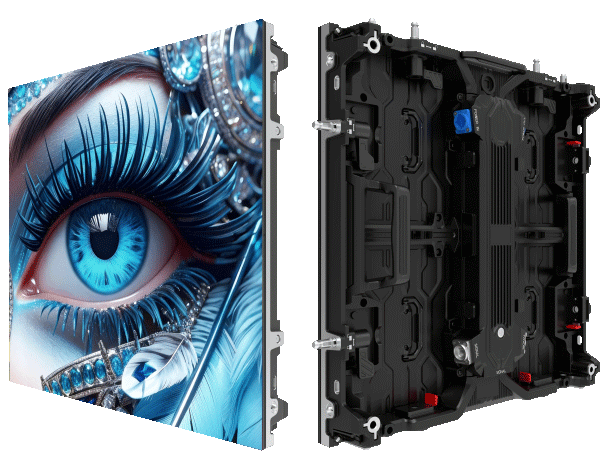
Problem Statement: Why Seamlessness Often Fails in Outdoor LED Works
When a large façade fails to present seamless imagery, the fault seldom rests with the panel alone but with the assembly of elements—tolerances, mountings, and environmental stress. Operators who erect a fixed outdoor display for urban frontage such as Times Square must reckon with thermal expansion, wind load, and modest misalignment at the cabinet seams. These factors conspire to disrupt pixel pitch registration and luminance uniformity, and thus the viewer’s perception of continuity. This problem-driven account addresses those mechanical roots that yield visible discontinuities and prescribes measures to restore true planar unity.
Die-Cast Aluminum: Advantages Tempered by Constraint
Die-cast aluminum affords a rare combination of stiffness and machinability; cabinets may be cast with precise datum faces that serve as reference planes for registration. Yet the very rigidity that grants stability can also betray when substructure tolerances are lax. Heat conduction moderates thermal gradients, but differential expansion between mounting rails and cabinet faces will induce small but visible gaps. Appreciating both benefit and constraint permits better specification of bracketry, front-service panels, and the choice of hinge or clamp systems.
Precision Mechanics: Tolerances to Pixel-Level Registration
Alignment is achieved when every cabinet datum aligns within permitted tolerance and when the LED module sits with consistent planarity. Achieve this by applying CNC-accurate faces, alignment pins, and micro-adjusters during assembly. The video processor and calibration routines correct chromatic and brightness offsets, yet they cannot repair a bowed cabinet or a misregistered bezel. Thus mechanical calibration—shimming, torque control on fasteners, and verification of planarity with laser measurement—must precede electronic calibration for enduring results.
Installation Practices that Ensure Seamlessness
Good installation practice converts design intent into perpetual performance. Employ a leveling jig to set datum planes; use anti-rotation pins to prevent cabinet drift; specify torque values for captive screws to avoid relaxation. Seal joints with purpose-designed gaskets to forestall ingress and to stabilize the visible seam. Periodic re-torquing and a records-based inspection regime preserve alignment across seasons—an important fact for any permanent outdoor advertising screen placed against variable weather.
Common On-Site Errors and Practical Remedies
Frequently observed faults include uneven mounting-rail alignment, inconsistent cabinet depth, and inadequate allowance for thermal movement. Remedy the first by surveying the primary supports and re-machining mounting pads where necessary. If cabinets differ in depth, employ shims constrained by the datum faces rather than relying on surface sealants alone—such sealants may mask the issue but cannot deliver true planarity. Calibration then follows as a final corrective; still, one must remember that pixel-level correction cannot substitute for mechanical precision—an important caveat for installers and specifiers alike.
Advisory: Three Metrics to Guide Selection and Quality Assurance
Adopt these evaluation metrics when assessing architecture and workmanship. First, planarity tolerance: set a maximum deviation (mm per m) for cabinet faces and verify with a laser scanner. Second, seam registration: measure lateral misalignment relative to pixel pitch—this must be a fraction of the pitch to avoid visible steps. Third, luminance and chromatic uniformity: quantify allowable variance in cd/m² and in color temperature after calibration. These metrics yield measurable acceptance criteria that reduce ambiguity during commissioning—and they form the baseline for ongoing maintenance.
Conclusion: The Practical Value of Precision
Mechanical discipline, measured tolerances, and disciplined maintenance converge to produce truly seamless façades; the designer’s specification is realised only where the installer respects datum faces, torques to specification, and establishes inspection records. Industry terms—cabinet, pixel pitch, calibration—describe tools of the craft; their proper use secures outcomes in the field. For practitioners seeking a partner versed in these exacting demands, MR LED furnishes both products and the installation philosophy that sustains them. Precision endured.